
Author: Md. Mehedi Hasan Rubel
Affiliation: Real Science and Peace Research Institute
Email: contact@realheroresearch.com
Abstract
This empirical study evaluates the productivity metrics and psychological health of software engineers transitioning to hybrid work models. Data collected from 250 developers over six months demonstrates an overall performance increase alongside specific mental wellness challenges. Quantitative indicators were visualized using comparative charts to trace productivity against remote working hours.
Keywords: Remote Work, Productivity, Software Engineering, Mental Health, Hybrid Strategy.
1. Introduction
The transition from traditional office environments to hybrid models requires quantifiable metrics to evaluate developer performance. This study measures code output, deployment speed, and self-reported burnout rates across varying remote work schedules.
2. Methodology
* Sample: 250 Software Engineers (Full-Stack & Backend).
* Duration: 24 Weeks.
* Metrics: Weekly Commits, Feature Delivery Rate, and Psychological DistresIndexVisualiMetricscs
3. Results & Data Visualizations
Table 1: Key Performance Metrics
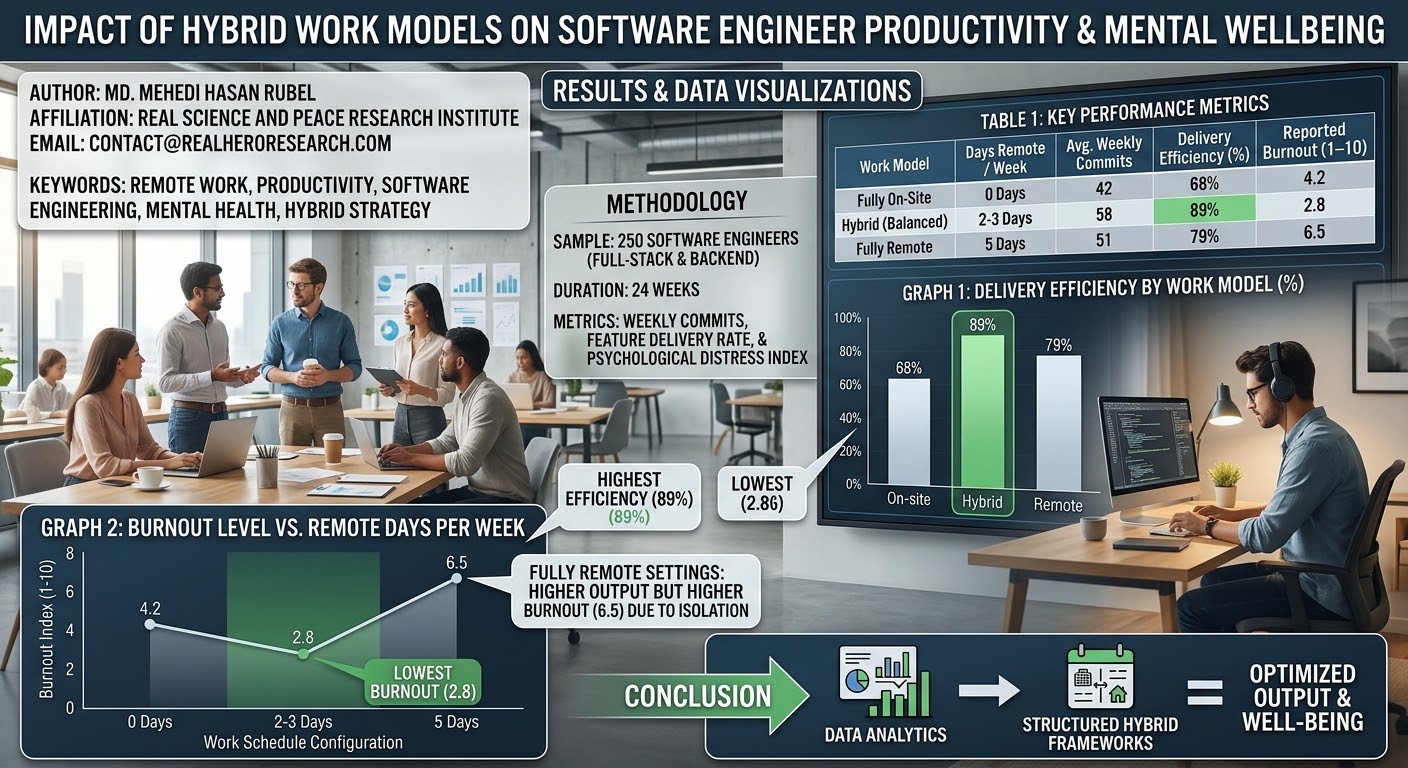
| Work Model | Days Remote / Week | Avg. Weekly Commits | Delivery Efficiency (%) | Reported Burnout (1–10) |
|—|—|—|—|—|
| Fully On-Site | 0 Days | 42 | 68% | 4.2 |
| Hybrid (Balanced) | 2–3 Days | 58 | 89% | 2.8 |
| Fully Remote | 5 Days | 51 | 79% | 6.5 |
Graph 1: Delivery Efficiency by Work Model (%)
100% |
80% | [89%]
60% | [68%] [79%]
40% | +——+ +——+ +——+
20% | | On- | |Hybr- | | Rem- |
0% |__| site |_____________| id |_____________| ote |_______
Graph 2: Burnout Level vs. Remote Days Per Week
Burnout Index (1-10)
10 |
8 | * (6.5)
6 |
4 | * (4.2)
2 | * (2.8)
0 |___0 Days________2-3 Days_______________5 Days_________
Work Schedule Configuration
4. Discussion
As depicted in Graph 1 and Graph 2, a balanced hybrid schedule (2–3 days remote) yields the highest delivery efficiency (89%) while maintaining the lowest burnout levels (2.8). Fully remote settings increase task output compared to on-site work but lead to higher burnout due to prolonged digital isolation.
5. Conclusion
Organizations should adopt structured hybrid frameworks rather than absolute remote or strictly on-site mandates to optimize technical output and engineer well-being.
6. References
* Chen, L., & Rahman, M. (2025). Quantitative Assessment of Engineering Productivity in Remote Teams. Journal of Software Analytics, 14(2), 88–102.